Common guides Semaglutide and tirzepatide (Ozempic, Wegovy, Mounjaro, Zepbound)
Ozempic hair loss: how common it is, and why weight loss plays a part
What the semaglutide and tirzepatide labels report about hair loss, who notices it most, and what the evidence says about getting your hair back.
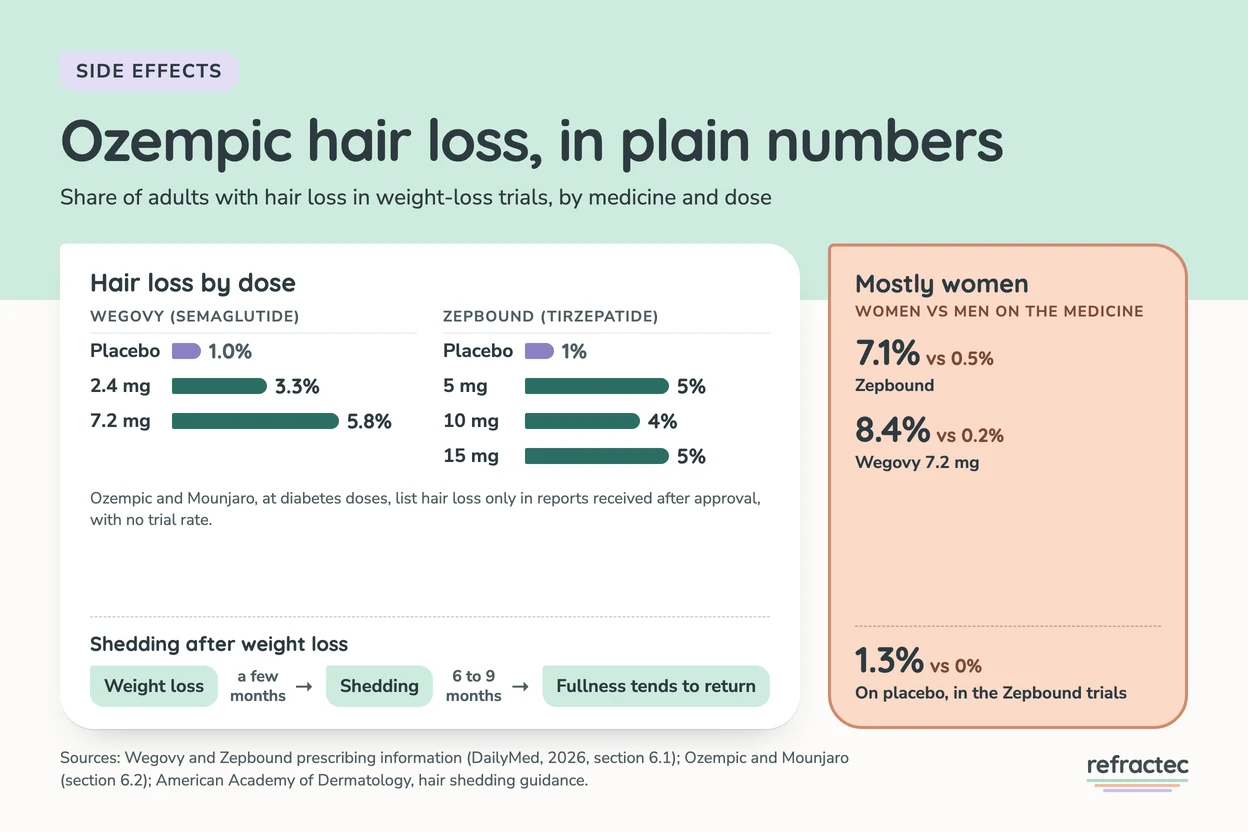
Ozempic hair loss is a common worry, and the labels do back it up, mostly at weight-loss doses. Ozempic and Wegovy contain the same medicine, semaglutide. On Wegovy 2.4 mg, about 3 in 100 people (3%) had hair loss, compared with 1 in 100 on placebo.1
The tirzepatide label for weight loss, Zepbound, reports a similar pattern.2 Both labels connect the hair loss to weight reduction. This guide walks through the numbers, who notices it most, and when your hair is likely to come back. For the other effects on the labels, see our guide to semaglutide side effects.
Does Ozempic cause hair loss?
It’s listed, but not in the main trial results. The Ozempic label’s trial tables don’t include hair loss. It appears under reports received after approval, as alopecia
, the medical word for hair loss.3 The Mounjaro label lists it the same way.4
Reports like these come in from patients and doctors, without a comparison group. The labels say they can’t be used to reliably estimate how often a side effect happens, or to prove it was caused by the medicine.3,4 For real numbers, we need the weight-loss labels, which have placebo groups.
How common is it on Wegovy and Zepbound?
In three Wegovy weight-loss trials, hair loss was reported by 3% of adults on the 2.4 mg dose, compared with 1% on placebo.1 In a trial in patients under 18, it was 4% on Wegovy and none on placebo.1
Zepbound’s numbers are a little higher. In its two main weight-loss trials, hair loss affected 5% of people on 5 mg and 4% on 10 mg. On 15 mg, it was 5%, compared with 1% on placebo.2 The Zepbound Medication Guide lists hair loss among the most common side effects.2
These trials ran for more than a year. Each label says rates from one medicine’s trials can’t be compared directly with another’s.1,2
Does a higher dose mean more hair loss?
For semaglutide, it seems to. The Wegovy label now includes a 7.2 mg dose for some adults. In those trials, 5.8% of people on 7.2 mg had hair loss, compared with 3.3% on 2.4 mg and 1.0% on placebo.1
On 7.2 mg, hair loss led to treatment being stopped for good once, paused once, and the dose being lowered five times.1 None of these happened on 2.4 mg or placebo. Your prescriber may adjust your dose, so talk with them before you change anything.
For Zepbound, the three doses had similar rates, between 4% and 5%.2 No one on Zepbound stopped treatment because of hair loss in those trials.2
Who is more likely to notice it?
Women, by a wide margin. On Zepbound, hair loss affected 7.1% of women and 0.5% of men. On placebo, it was 1.3% of women and no men.2
The same gap shows up on Wegovy. On 7.2 mg, 8.4% of women had hair loss, compared with 0.2% of men.1 On 2.4 mg in the main weight-loss trials, it was 4% of women and 0.9% of men.1
A 2026 review of 24 studies reached a similar view. It found semaglutide and tirzepatide had the highest rates of hair loss among GLP-1 medicines, and said Females appeared to be disproportionately affected.
6
Why would weight loss cause hair loss?
Both labels say the hair loss was associated with weight reduction
.1,2 That fits a pattern dermatologists know well. Your body can shed extra hair a while after a big physical change.
The American Academy of Dermatology (AAD) lists losing 20 pounds or more among the triggers for this kind of shedding.5 It says It’s normal to shed between 50 and 100 hairs a day.
5 After a trigger, many more hairs can fall out at once.
The 2026 review found the same thing in GLP-1 users. It said Rapid weight loss emerged as a potential contributor
, especially for this shedding type.6 But the review also called for better studies, so the exact cause isn’t proven.6 It hasn’t been shown that these medicines harm hair roots directly.
How much weight are we talking about?
A lot, for many people. In Zepbound’s main trial, people started at about 105 kg (231 pounds) on average.2 After 72 weeks, those on 15 mg had lost 20.9% of their body weight on average, compared with 3.1% on placebo.2
For an average person in that trial, that’s more than 40 pounds. It’s well past the 20-pound mark the AAD lists as a trigger for shedding.5 Lower doses led to less weight loss, but still far more than placebo: 15.0% on 5 mg and 19.5% on 10 mg.2
When does it start, and will it grow back?
The AAD says most people notice extra shedding a few months after the stressful event
.5 So the hair you lose today may reflect weight you lost months ago. That’s why it can show up even after your weight has steadied.
For most people, this kind of shedding settles without treatment. The AAD says that within six to nine months, hair tends to return to its normal fullness.5 That advice is about shedding in general. It hasn’t been studied in GLP-1 users specifically, so we can’t promise the same timeline.
The labels don’t say whether hair loss on these medicines is permanent.1,2
Can I prevent it?
There’s no proven way yet. The labels don’t give advice on preventing hair loss.1,2 We found no trials that tested a way to prevent it in people on these medicines, and no good evidence that supplements like biotin help.
The 2026 review called for better studies to sort out the cause.6 Until then, the most useful step is a talk with your prescriber. Ask whether your pace of weight loss, and how much you’re managing to eat, look right for you.
When should I see a doctor about it?
Hair loss has many causes besides weight loss, and some of them need their own treatment. Ask your prescriber or a dermatologist to take a look if something seems off.
That includes bald patches, a sore or red scalp, or shedding that keeps getting worse after several months. If hair loss makes you want to stop your medicine, talk with your prescriber first.
Questions to ask your prescriber
Bring these to your next appointment. Tick them off as you go.
Endnotes
- What the Wegovy label says about hair loss. Wegovy (semaglutide) injection and tablets, prescribing information and Medication Guide, Novo Nordisk. Label revised Jun 2026; DailyMed, updated Jun 18, 2026. Retrieved Oct 2026.
- What the Zepbound label says about hair loss. Zepbound (tirzepatide) injection, prescribing information and Medication Guide, Eli Lilly and Company. Label revised Aug 2026; DailyMed, updated Aug 28, 2026. Retrieved Oct 2026.
- What the Ozempic label says about hair loss. Ozempic (semaglutide) injection, prescribing information, Novo Nordisk. Label revised May 2026; DailyMed, updated Jun 1, 2026. Retrieved Oct 2026.
- What the Mounjaro label says about hair loss. Mounjaro (tirzepatide) injection, prescribing information, Eli Lilly and Company. Label revised Aug 2026. DailyMed. Retrieved Oct 2026.
- Hair shedding after a big change, from dermatologists. American Academy of Dermatology. Do you have hair loss or hair shedding? Patient guidance, aad.org. Retrieved Oct 2026.
- A 2026 review of GLP-1 medicines and hair loss. Gupta AK, Teasell EM, Economopoulos V, Mirmirani P. GLP-1 therapies and hair loss: A systematic review of current evidence and implications for counseling. Sci Prog. 2026;109(2). doi:10.1177/00368504261444578.
Reviewed against the sources above on Oct 19, 2026. Spotted something out of date? The desk dates every correction on the page.