Common guides Tirzepatide (Zepbound, Mounjaro)
Tirzepatide side effects, dose by dose
Nausea, diarrhea and the other common effects at each dose, the rare warnings, and the 2026 label changes, all taken from the FDA labels.
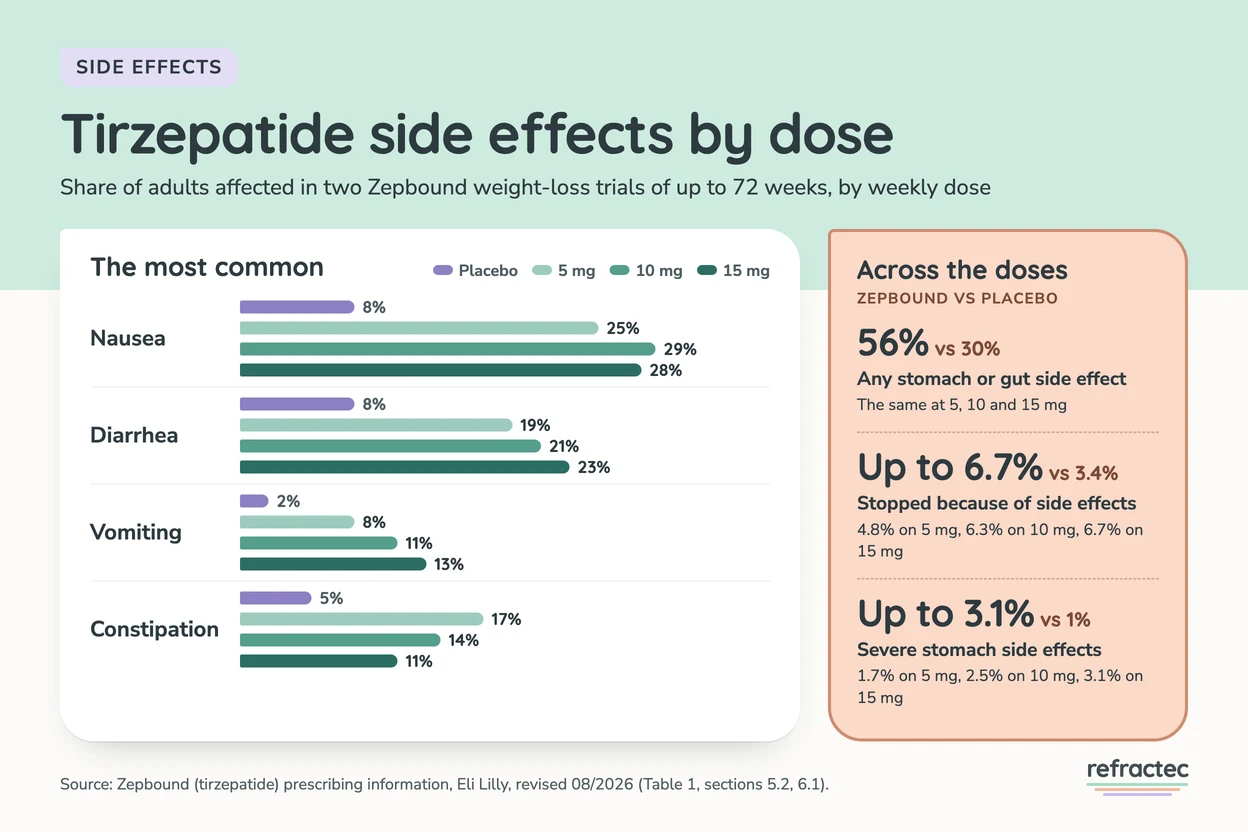
The most common tirzepatide side effects are stomach and gut problems: nausea, diarrhea, vomiting and constipation.1 They show up most while your dose is being raised, and the labels say they decreased over time.1 A short list of serious risks is rare but worth knowing by name.
This guide walks through the FDA labels for Zepbound and Mounjaro, dose by dose. Every figure sits beside its placebo figure, so you can see how much comes from the medicine.
Which medicines contain tirzepatide?
Tirzepatide is made by Eli Lilly and sold under two names. Zepbound is a weekly injection for weight management in adults. It’s also approved to treat moderate to severe obstructive sleep apnea in adults who have obesity.1 Mounjaro is a weekly injection for type 2 diabetes in adults and in children 10 years and older.3
The two labels report different trials with different people. The labels say side effect rates from one drug’s trials cannot be directly compared
to rates from another drug’s trials.1 So the Zepbound and Mounjaro numbers below are best read side by side, not as a contest.
What are the most common tirzepatide side effects?
The biggest set of numbers comes from two Zepbound weight-loss trials. They included 2,519 adults treated for up to 72 weeks, about a quarter of whom had type 2 diabetes.1 One of them was SURMOUNT-1, a 72-week trial in adults without diabetes.4
Nausea led the list. It affected about 25 to 29 in 100 people (25% to 29%) on Zepbound, depending on the dose, compared with 8 in 100 on placebo.1 Diarrhea affected 19% to 23%, compared with 8% on placebo.1
| Side effect | Placebo | 5 mg | 10 mg | 15 mg |
|---|---|---|---|---|
| Nausea | 8% | 25% | 29% | 28% |
| Diarrhea | 8% | 19% | 21% | 23% |
| Vomiting | 2% | 8% | 11% | 13% |
| Constipation | 5% | 17% | 14% | 11% |
| Stomach pain | 5% | 9% | 9% | 10% |
| Indigestion | 4% | 9% | 9% | 10% |
| Injection site reactions | 2% | 6% | 8% | 8% |
| Tiredness | 3% | 5% | 6% | 7% |
The table comes from the Zepbound label.1 Stomach pain here includes upper, lower and general belly pain or discomfort. Tiredness includes weakness and feeling unwell.
Do side effects get worse at higher doses?
Some do, a little. Vomiting rose from 8% on 5 mg to 13% on 15 mg, compared with 2% on placebo.1 Diarrhea also crept up with the dose.
Nausea was about the same at 10 mg and 15 mg (29% and 28%).1 Constipation went the other way. It was most common at 5 mg (17%) and least common at 15 mg (11%), compared with 5% on placebo.1
Counted together, any stomach or gut side effect affected 56% of people at each dose, compared with 30% on placebo.1 So the chance of having one was the same at 5, 10 or 15 mg. Higher doses mostly changed which ones showed up, and how often people stopped.
When do the stomach side effects happen?
Mostly early. The Zepbound label says most nausea, vomiting and diarrhea occurred during dose escalation and decreased over time
.1 The label doesn’t say how many days a single bout of nausea tends to last.
That’s why the dose starts low and climbs slowly. Zepbound starts at 2.5 mg once a week for 4 weeks, and the label says this starting dose isn’t meant to be kept long term.1 After that, the dose goes to 5 mg. It can then rise in 2.5 mg steps, with at least 4 weeks at each step.1
The usual maintenance dose is 5, 10 or 15 mg a week for weight, or 10 or 15 mg for sleep apnea. The most anyone takes is 15 mg a week.1 Mounjaro follows the same 2.5 mg start and 2.5 mg steps, with a top dose of 15 mg for adults and 10 mg for children.3
If a maintenance dose is hard to tolerate, the Zepbound label lets your prescriber consider a lower one.1 That choice belongs to your prescriber, so check with them before changing or skipping anything.
How many people stop tirzepatide because of side effects?
Most people kept going. In the two Zepbound trials, 4.8% stopped for good because of side effects on 5 mg, 6.3% on 10 mg and 6.7% on 15 mg. That compares with 3.4% on placebo.1
Stomach problems were the main reason. Most people who stopped did so in the first few months.1 Stopping because of stomach side effects rose with the dose: 1.9%, 3.3% and 4.3%, compared with 0.5% on placebo.1
What other side effects are on the label?
- Injection site reactions. Redness, itching, bruising or pain where you inject affected 6% to 8%, compared with 2% on placebo.1 They were more common in people whose bodies made antibodies to tirzepatide (11.3% compared with 1%).1
- Allergic reactions. These affected 5% at each dose, compared with 3% on placebo. Most were skin reactions like rash or itching.1
- Burping, heartburn and gas. Burping affected 4% to 5% (1% on placebo), and heartburn or reflux 4% to 5% (2% on placebo).1
- Hair loss. It affected 4% to 5%, compared with 1% on placebo. The label links it to weight loss, and it was much more common in women (7.1%) than in men (0.5%).1
- Dizziness and low blood pressure. Dizziness affected 4% to 5% (2% on placebo). Low blood pressure affected 1.6%, compared with 0.1%, and was more common in people on blood pressure medicine.1
- A faster heartbeat. On average, resting heart rate rose by 1 to 3 beats per minute.1
- Low blood sugar, if you have diabetes. In the trial of adults with type 2 diabetes, 4.2% had low blood sugar, compared with 1.3% on placebo.1 It was 10.3% in people who also took a sulfonylurea, compared with 2.1% in those who didn’t.1
Are Mounjaro side effects different from Zepbound?
The list is much the same, but the numbers are lower. Mounjaro’s main table comes from 718 adults with type 2 diabetes, treated for about 37 weeks on average.3
In those trials, nausea affected 12% on 5 mg, 15% on 10 mg and 18% on 15 mg, compared with 4% on placebo.3 Diarrhea affected 12% to 17% (9% on placebo), and a smaller appetite 5% to 11% (1% on placebo).3 Any stomach or gut side effect rose with the dose, from 37.1% to 43.6%, compared with 20.4% on placebo.3
Children 10 and older had more vomiting and belly pain than adults. During the placebo-controlled part of their trial, vomiting affected 16% on 5 mg and 12% on 10 mg, compared with 3% on placebo.3
What serious side effects are on the label?
These are rare, but each one is a labeled warning. Knowing the signs helps you act early.
- Severe stomach side effects. In the Zepbound trials, these affected 1.7% on 5 mg, 2.5% on 10 mg and 3.1% on 15 mg, compared with 1% on placebo.1 The label says Zepbound
is not recommended in patients with severe gastroparesis
, a condition where the stomach empties very slowly.1 - Kidney problems from fluid loss. Vomiting and diarrhea can dry you out. Kidney injury affected 0.5% in the trials (0.2% on placebo), and later reports include cases needing dialysis.1 The Medication Guide asks you to drink fluids.2
- Gallbladder problems. Gallbladder inflammation affected 0.7%, compared with 0.2% on placebo.1
- Pancreatitis. In the Zepbound weight-loss trials, it was confirmed in 0.2% of people on Zepbound and 0.2% on placebo.1 The main sign is severe belly pain that won’t go away, sometimes felt in your back.2
- Serious allergic reactions. Reports since approval include anaphylaxis and swelling of the face or throat.1
- Anesthesia and sedation. Tirzepatide slows how fast your stomach empties. In rare reports, people under anesthesia or deep sedation inhaled food or fluid left in the stomach.1 Tell everyone on your care team that you use it before any planned procedure.
- Eye changes with diabetes. If you have type 2 diabetes and a history of diabetic retinopathy, the label asks your care team to watch for it getting worse.1
- The thyroid warning. Both labels carry a boxed warning because tirzepatide caused thyroid C-cell tumors in rats. It’s not known whether this happens in people.1,3 You shouldn’t use tirzepatide if you or a close relative has had medullary thyroid cancer, or if you have MEN 2.1
Since approval, people have also reported blocked bowels and severe constipation with hard, stuck stool.1 Reports like these come in voluntarily. The label says it isn’t always possible to estimate how often they happen or to prove the medicine caused them.1
What changed on the label in 2026?
Several things. In February 2026, the Zepbound label updated its warning on severe stomach side effects and removed a warning on suicidal behavior and thoughts.1 In January 2026, it added that a Zepbound KwikPen must never be shared, even with a new needle.1 The section on diabetic eye problems was updated in August 2026.1
The suicidal-thoughts change followed an FDA request dated Jan 13, 2026. The FDA’s review included 91 placebo-controlled trials with 107,910 patients.5
Mounjaro’s label changed too. It added children 10 and older in December 2025, and a use to lower the risk of major heart events in August 2026.3 Labels keep changing, so your pharmacist can print the current version for you.
Questions to ask your prescriber
Bring these to your next appointment. Tick them off as you go.
Endnotes
- What the Zepbound label says about side effects. Zepbound (tirzepatide) injection, prescribing information, Eli Lilly and Company. Revised 08/2026; DailyMed, updated Aug 28, 2026. Retrieved Oct 2026.
- What the Zepbound Medication Guide tells patients. Zepbound (tirzepatide) injection, Medication Guide, Eli Lilly and Company. Revised 08/2026. Retrieved Oct 2026.
- What the Mounjaro label says about side effects. Mounjaro (tirzepatide) injection, prescribing information, Eli Lilly and Company. Revised 08/2026; DailyMed, updated Aug 27, 2026. Retrieved Oct 2026.
- The SURMOUNT-1 weight-loss trial. Jastreboff AM, Aronne LJ, Ahmad NN, et al. Tirzepatide Once Weekly for the Treatment of Obesity. N Engl J Med. 2022;387(3):205-216. doi:10.1056/NEJMoa2206038.
- Why the FDA asked for the suicidal-thoughts warning to come off. U.S. Food and Drug Administration. FDA requests removal of suicidal behavior and ideation warning from glucagon-like peptide-1 receptor agonist (GLP-1 RA) medications. Drug Safety Communication, Jan 13, 2026.
Reviewed against the sources above on Oct 19, 2026. Spotted something out of date? The desk dates every correction on the page.