Serious guides Retatrutide (investigational, not approved)
Retatrutide side effects: what the trials have reportedNot approved
Retatrutide is an investigational drug, not approved anywhere. Here is what its trials have reported about side effects so far, and why products sold online are a different risk.
Retatrutide is not approved. It’s an investigational drug made by Eli Lilly, and no regulator anywhere has approved it.1 Retatrutide side effects are known only from clinical trials so far. In those trials, the most common problems were nausea, diarrhea and other stomach effects, much like approved GLP-1 medicines.2,3,10
This guide covers what the Phase 2 and Phase 3 trials have reported. Several Phase 3 results so far come only from Lilly’s own announcements, and we say so where that’s the case. It doesn’t cover how to take retatrutide, because there is no approved dose.
Is retatrutide approved?
No. Lilly says retatrutide has not been approved by any regulatory agency
.1 It says no one should take anything claiming to be retatrutide outside a Lilly-sponsored trial.1 The FDA says retatrutide cannot be used in compounding under federal law
.4 The FDA has also warned telehealth companies for marketing it.4
Lilly says it plans to apply to the FDA for approval in the first three months of 2027.5 A plan to apply is not an approval, and the FDA’s review could take time. A large trial of heart and kidney outcomes, TRIUMPH-Outcomes, is still running.6
How is retatrutide different from Wegovy or Zepbound?
Retatrutide acts on three hormone targets: GLP-1, GIP and glucagon.2 That’s why it’s sometimes called a “triple agonist.”
Acting on more targets doesn’t mean the side effects are already understood. Large trials are how researchers learn which effects are common and which are rare.
What side effects did people have in the trials?
Stomach side effects led every trial. The Phase 2 obesity trial, in 338 adults, found they were dose-related
and mostly mild to moderate in severity
.2 The NEJM paper on TRIUMPH-1, a Phase 3 trial in 2,339 adults with obesity, also says The most common adverse events were gastrointestinal.
3
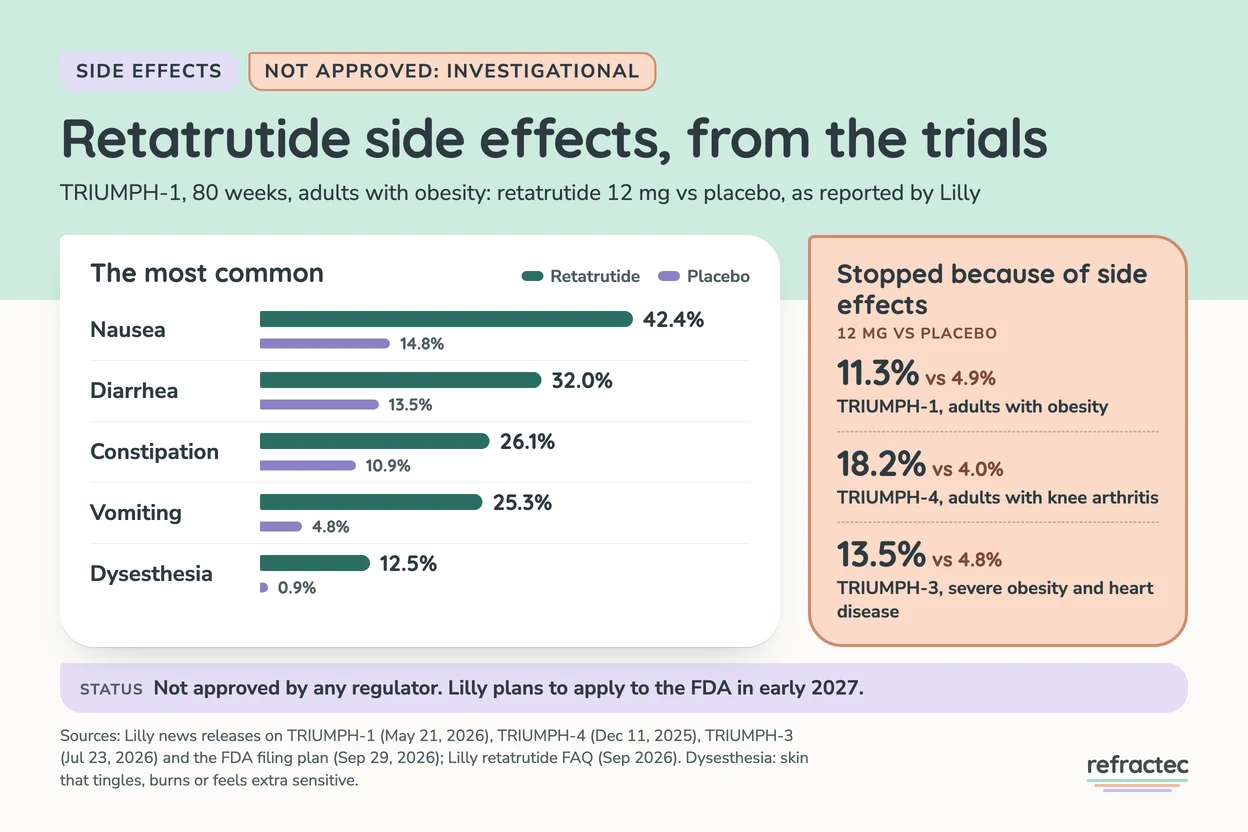
Lilly reported the full list for TRIUMPH-1. On the 12 mg dose, nausea affected 42.4% of people, compared with 14.8% on placebo.7 Diarrhea affected 32.0% compared with 13.5%, and vomiting 25.3% compared with 4.8%.7
| Side effect | Share of people, medicine then placebo |
|---|---|
| Nausea | Medicine 42.4%Placebo 14.8% |
| Diarrhea | Medicine 32%Placebo 13.5% |
| Constipation | Medicine 26.1%Placebo 10.9% |
| Vomiting | Medicine 25.3%Placebo 4.8% |
| Dysesthesia | Medicine 12.5%Placebo 0.9% |
| Urinary infection | Medicine 8.4%Placebo 5.3% |
Share of adults with each side effect on retatrutide 12 mg or placebo over 80 weeks in TRIUMPH-1, a trial in adults with obesity without diabetes. Figures are from Lilly's announcement of the results. Dysesthesia means skin that feels tingly, burning or extra sensitive.7
The trial lasted 80 weeks and tested three doses: 4 mg, 9 mg and 12 mg.3 We name these doses only to explain the trial results. They are not a guide for anyone.
Does the dose make a difference?
Yes. In TRIUMPH-1, nausea rose from 28.6% on 4 mg to 38.4% on 9 mg and 42.4% on 12 mg.7 Vomiting rose from 10.6% to 22.8% and 25.3%, compared with 4.8% on placebo.7
The starting dose mattered too. In the Phase 2 trial, stomach side effects were partially mitigated with a lower starting dose
.2 In the trial’s posted results, 21 of 35 people (60%) who started the 8 mg arm at a higher first dose had nausea.8 Of 35 who started the same arm at a lower first dose, 6 (17%) had nausea, compared with 8 of 70 (11%) on placebo.8
What is dysesthesia, and how often did it happen?
Dysesthesia is skin that feels different: tingling, burning, prickling or extra sensitive to touch. It showed up more often than on placebo in each of these Phase 3 trials.
- TRIUMPH-1. It affected 12.5% on 12 mg, compared with 0.9% on placebo, as reported by Lilly.7
- TRIUMPH-4. This trial was in adults with knee arthritis. Lilly reported dysesthesia in 20.9% on 12 mg, compared with 0.7% on placebo.9
- TRIUMPH-2. In adults with type 2 diabetes, the Lancet paper reports 7% on 12 mg, compared with 1% on placebo.10
Lilly says these events were generally mild to moderate
, that most went away during treatment, and that most people kept taking retatrutide.7 The sources we checked don’t explain why it happens. If your skin feels strange during a trial, tell your study team.
How many people stopped because of side effects?
It depended on the trial and the dose. In TRIUMPH-1, 11.3% on 12 mg stopped because of side effects, compared with 4.9% on placebo.7 On 4 mg, it was 4.1%, close to placebo.7
TRIUMPH-4 had the highest rate. There, 18.2% on 12 mg stopped because of side effects, compared with 4.0% on placebo.9 Lilly says these rates were highly correlated with baseline BMI
and included people who stopped because they felt they had lost too much weight.9
Are side effects different with diabetes or heart disease?
The pattern looks similar, though the numbers differ by trial. In a Phase 2 trial of 281 adults with type 2 diabetes, mild to moderate stomach side effects affected 35% on retatrutide.11 That compared with 13% on placebo and 35% on dulaglutide (Trulicity), an approved GLP-1 medicine. The paper reports no reports of severe hypoglycaemia and no deaths during the study.
11
TRIUMPH-2 tested retatrutide in 1,152 adults with obesity and type 2 diabetes for 80 weeks.10 On 12 mg, nausea affected 28% and diarrhea 34%, compared with 8% and 13% on placebo.10
TRIUMPH-3 enrolled adults with severe obesity and heart disease. Lilly reported nausea in 22.4% on 12 mg, compared with 5.8% on placebo.12 In that trial, 13.5% on 12 mg stopped because of side effects, compared with 4.8% on placebo.12
What other effects have been reported?
- Heart rate. In the Phase 2 trial, heart rate rose with dose. It
peaked at 24 weeks and declined thereafter
.2 - Low blood pressure. In TRIUMPH-2, low blood pressure affected 6% on 12 mg, compared with under 1% on placebo.10
- Urinary tract infections. In TRIUMPH-1, they affected 8.4% on 12 mg, compared with 5.3% on placebo.7
What about serious side effects?
The data here are still thin. The Phase 2 obesity trial posted its results on ClinicalTrials.gov. Serious events of any kind affected 10 of 267 people on retatrutide (3.7%), compared with 3 of 70 on placebo (4.3%).8 They included one case of acute pancreatitis and one of acute gallbladder inflammation, both on retatrutide.8
In TRIUMPH-2, six people on retatrutide and one on placebo died. The trial investigators judged that none of these deaths were related to the study drug.10 The Phase 3 sources we could check don’t give overall serious-event rates, or rates of pancreatitis or gallbladder disease.
What are the risks of retatrutide sold online?
Products sold online as retatrutide are not the trial drug. Lilly warns that illicit products may contain unknown ingredients, harmful contaminants and impurities
, or the wrong amount of drug.1 The FDA has warned companies selling retatrutide that was falsely labeled for research purposes
or not for human consumption
.4
A 2026 study looked at Reddit posts from 7,823 people who said they used unapproved retatrutide.13 The most common complaints were increased appetite (17.1%), tiredness (15.2%) and nausea (11.6%). The authors say this kind of study cannot assess incidence, causality, dose-response, or comparative safety
.13
A 2026 case report describes a woman in her mid-20s who was admitted to hospital with 5 days of nausea and vomiting.14 She had received 4 weekly injections of an unverified product said to contain retatrutide. Her symptoms cleared within a week.14
If you’ve used one of these products, tell your doctor what you took and when. Bring the vial or packaging if you still have it.
Questions to ask your prescriber
Bring these to your next appointment. Tick them off as you go.
Endnotes
- Lilly's own answers about retatrutide. Eli Lilly and Company. What to know about retatrutide. Last updated September 2026. Retrieved Oct 19, 2026.
- The Phase 2 obesity trial. Jastreboff AM, Kaplan LM, Frías JP, et al. Triple-Hormone-Receptor Agonist Retatrutide for Obesity: A Phase 2 Trial. N Engl J Med. 2023;389(6):514-526. doi:10.1056/NEJMoa2301972. Funded by Eli Lilly. PubMed abstract retrieved Oct 19, 2026.
- The TRIUMPH-1 journal paper. Jastreboff AM, Kaplan LM, Davies MJ, et al. Retatrutide, a Triple Hormone Receptor Agonist, for Treatment of Obesity. N Engl J Med. Published online Sep 29, 2026. doi:10.1056/NEJMoa2604169. Funded by Eli Lilly. PubMed abstract retrieved Oct 19, 2026.
- The FDA's warning about unapproved GLP-1 drugs. US Food and Drug Administration. FDA's Concerns with Unapproved GLP-1 Drugs Used for Weight Loss. Content current as of Oct 1, 2026. Retrieved Oct 19, 2026.
- Lilly's plan to apply to the FDA. Eli Lilly and Company. Lilly's triple agonist, retatrutide, delivered substantial weight loss and A1C reduction, underscoring its potential promise for people with obesity and type 2 diabetes. News release, Sep 29, 2026. Retrieved Oct 19, 2026.
- The heart and kidney outcomes trial still under way. ClinicalTrials.gov. The Effect of Retatrutide Once Weekly on Cardiovascular Outcomes and Kidney Outcomes in Adults Living With Obesity (TRIUMPH-Outcomes), NCT06383390. Status: active, not recruiting (verified Oct 2026). Retrieved Oct 19, 2026.
- Lilly's results announcement for TRIUMPH-1. Eli Lilly and Company. Lilly's triple agonist, retatrutide, delivered powerful weight loss in pivotal Phase 3 obesity trial. News release, May 21, 2026. Trial NCT05929066. Retrieved Oct 19, 2026.
- The Phase 2 obesity trial's posted results. ClinicalTrials.gov. A Study of LY3437943 in Participants Who Have Obesity or Overweight, NCT04881760. Results: adverse events, baseline to up to 52 weeks. Retrieved Oct 19, 2026.
- Lilly's results announcement for TRIUMPH-4. Eli Lilly and Company. Lilly's triple agonist, retatrutide, delivered weight loss of up to an average of 71.2 lbs along with substantial relief from osteoarthritis pain in first successful Phase 3 trial. News release, Dec 11, 2025. Trial registered as NCT05931367 on ClinicalTrials.gov. Retrieved Oct 19, 2026.
- The TRIUMPH-2 journal paper, in people with type 2 diabetes. Bellido V, le Roux CW, Ekinci EI, et al. Retatrutide in adults with obesity and type 2 diabetes (TRIUMPH-2): a double-blind, parallel-group, randomised, placebo-controlled, phase 3 trial. Lancet. 2026;408(10563):1455-1472. doi:10.1016/S0140-6736(26)01861-1. Funded by Eli Lilly. PubMed abstract retrieved Oct 19, 2026.
- The Phase 2 trial in people with type 2 diabetes. Rosenstock J, Frias J, Jastreboff AM, et al. Retatrutide, a GIP, GLP-1 and glucagon receptor agonist, for people with type 2 diabetes: a randomised, double-blind, placebo and active-controlled, parallel-group, phase 2 trial conducted in the USA. Lancet. 2023;402(10401):529-544. doi:10.1016/S0140-6736(23)01053-X. Funded by Eli Lilly. PubMed abstract retrieved Oct 19, 2026.
- Lilly's results announcement for TRIUMPH-2 and TRIUMPH-3. Eli Lilly and Company. Lilly's triple agonist, retatrutide, successful in two additional Phase 3 obesity trials, delivering significant improvements in weight and A1C. News release, Jul 23, 2026. Retrieved Oct 19, 2026.
- What people using unapproved retatrutide reported on social media. Sehgal NKR, Tronieri JS, Rader B, Ungar L, Guntuku SC. Self-Reported Adverse Effects Among Social Media Users Taking Nonapproved Retatrutide. JAMA Netw Open. 2026;9(10):e2638929. doi:10.1001/jamanetworkopen.2026.38929. Retrieved Oct 19, 2026.
- A hospital case after injections sold as retatrutide. Buzzi RM, Huber LC. Emerging risks of health optimisation: refractory nausea associated with peptide injections reported to contain retatrutide. BMJ Case Rep. 2026;19(10):e276106. doi:10.1136/bcr-2026-276106. PubMed abstract retrieved Oct 19, 2026.
Reviewed against the sources above on Oct 20, 2026. Spotted something out of date? The desk dates every correction on the page.