Serious guides Semaglutide (Ozempic, Wegovy)
Ozempic and stomach paralysis: what's known, what isn't
The label's wording on severe stomach problems, why semaglutide slows the stomach, what claims-database studies found, and what the lawsuits do and don't show.
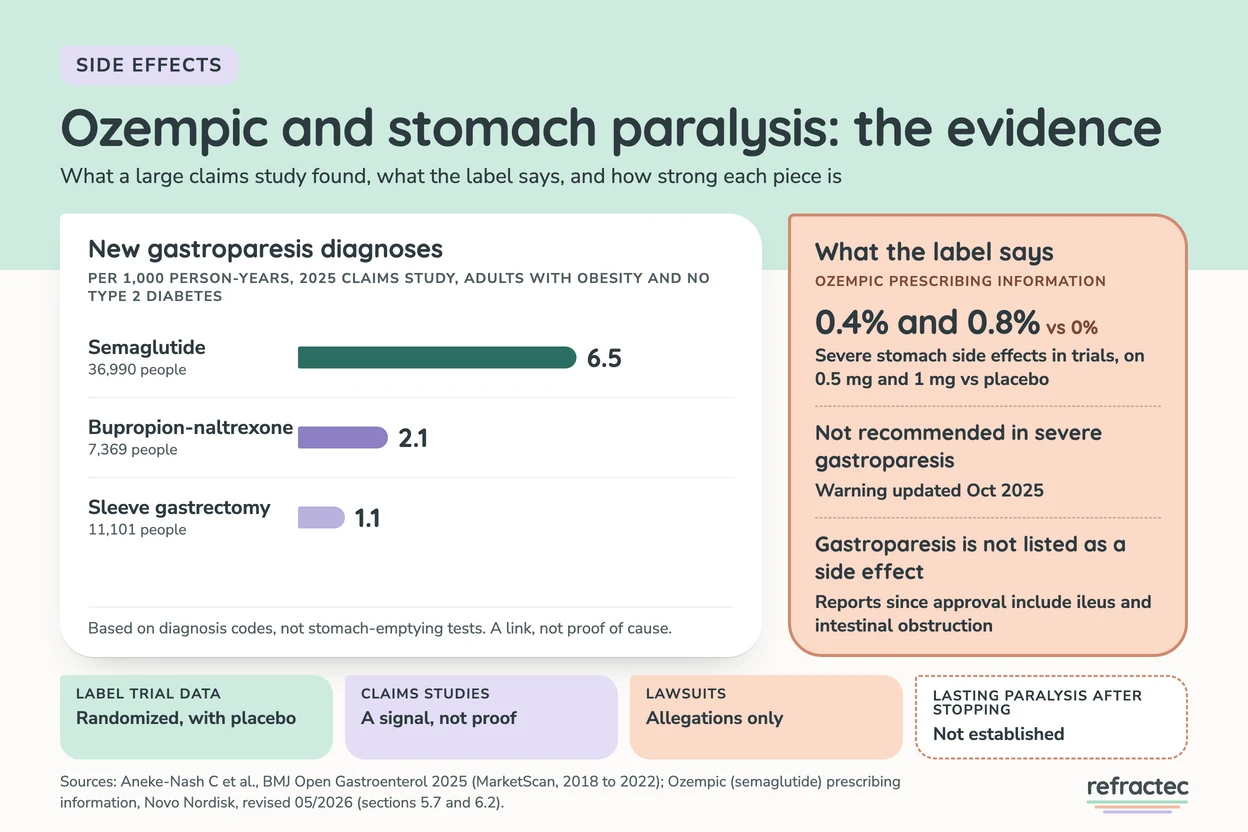
“Ozempic stomach paralysis” is the everyday name for gastroparesis, a condition where the stomach empties far too slowly. Ozempic does slow your stomach, and the label warns about stomach side effects that are sometimes severe.1 Whether it causes true gastroparesis is less clear, and that’s what this guide sorts out.
We’ll look at the label wording, how the medicine affects your stomach, what the studies found and how strong they are. We’ll also cover the lawsuits, and the symptoms that mean you should call.
What is “stomach paralysis” (gastroparesis)?
Gastroparesis is a disorder that slows or stops food moving from your stomach into your small intestine.5 It isn’t common. About 10 in 100,000 men and 40 in 100,000 women have it.5
Symptoms include feeling full soon after you start eating, or long after a meal. Nausea, vomiting, bloating, belching, upper belly pain, heartburn and a poor appetite are on the list too.6 Many of these overlap with ordinary GLP-1 side effects, which is part of the confusion.
To diagnose it, doctors need more than symptoms. A US gastroenterology guideline requires symptoms of food staying in the stomach, plus a test result. In its words, that’s objective evidence of delayed gastric emptying in the absence of mechanical obstruction in the gastric outflow
.8 The usual test is a gastric emptying scan, which typically takes about 4 hours.7
Who gets gastroparesis without a GLP-1?
Diabetes is the most common known cause. Over time, it can damage the nerves that control the stomach muscles.6 In most cases, though, doctors can’t find a cause at all, even with tests.6
This matters when you read the studies. Ozempic is a diabetes medicine, so many people taking it already have the most common risk factor. Some other medicines slow the stomach too, like opioid pain pills and some antidepressants.6
What does the Ozempic label say?
The label has a warning section called “Severe Gastrointestinal Adverse Reactions”. It was listed as a recent change dated October 2025.1 It says use of Ozempic has been associated with gastrointestinal adverse reactions, sometimes severe
.1
In Ozempic’s diabetes trials, severe stomach side effects affected 0.4% on 0.5 mg and 0.8% on 1 mg, compared with 0% on placebo.1 The section ends with one plain sentence:
OZEMPIC® is not recommended in patients with severe gastroparesis.
That sentence is about people who already have severe gastroparesis.1 The Medication Guide asks you to speak up before you start. Tell your provider if you have severe problems with your stomach, such as slowed emptying of your stomach (gastroparesis) or problems with digesting food.
1
The label does not list gastroparesis as a side effect caused by Ozempic. Reports since approval include a stalled bowel (ileus), a blocked bowel (intestinal obstruction) and severe constipation with hard, stuck stool.1 Reports like these are voluntary, so the label says their frequency can’t be reliably estimated.1
The same “not recommended” sentence appears on the Wegovy, Zepbound and Mounjaro labels.2,3,4 In Wegovy’s weight-loss trials, severe stomach side effects affected 4.1% on the injection, compared with 0.9% on placebo.2
How does Ozempic slow the stomach, and does it wear off?
Slowing the stomach is part of how the medicine works. The Ozempic label says semaglutide causes a delay of early postprandial gastric emptying
, which slows the rise in blood sugar after a meal.1 The Wegovy Medication Guide puts it simply: the medicine slows stomach emptying
.2
There are hints the effect lessens over time. In a separate study listed on the Ozempic label, no apparent effect on the rate of gastric emptying was observed with semaglutide 2.4 mg
.1 For tirzepatide, the label says the delay is largest after the first dose and this effect diminishes over time
.3
A small tirzepatide study found the same pattern. The slowing seen after one dose faded after several doses, though some delay remained in people with type 2 diabetes.11 The study was short (4 weeks) and funded by the drug’s maker.11
What do the studies show, and how strong is the evidence?
The worry began with insurance-claims studies. These look back at billing records, so they can show a link but not prove cause. They also count diagnosis codes, not confirmed stomach-emptying tests.
| Study | Semaglutide users | Gastroparesis per 1,000 person-years | Comparison drug |
|---|---|---|---|
| 2023, JAMA | 613 | 9.1 | 3.1 |
| 2025, BMJ Open Gastroenterology | 36,990 | 6.5 | 2.1 |
In both studies, the comparison drug was bupropion-naltrexone. It’s another weight-loss medicine.9,10 A “person-year” is one person followed for one year. So 6.5 per 1,000 person-years means about 6 or 7 new diagnoses for every 1,000 people followed for a year.
The 2023 study used US claims data from 2006 to 2020. After allowing for other factors, people on semaglutide were about 3.7 times as likely to get the diagnosis.9 But the semaglutide group was small, and the range of likely values was very wide (1.15 to 11.90).9 The authors noted that whether GLP-1 agonists were all used for weight loss is uncertain
.9
The 2025 study was much larger. It covered 55,460 adults from 2018 to 2022: 36,990 on semaglutide, 7,369 on bupropion-naltrexone and 11,101 who had sleeve gastrectomy surgery.10 Their risk was about 3.3 times that of people on the comparison drug. Compared with the surgery group (1.1 per 1,000 person-years), the risk was about 6 times higher.10 It was funded by Intuitive Surgical, a company that makes surgical robots.10
Put together, this is a signal from observational studies. The numbers suggest more gastroparesis diagnoses on semaglutide, but the absolute rate stays low. We found no primary source showing that the stomach stays “paralyzed” after the medicine is stopped.
What about the lawsuits?
People have sued Novo Nordisk and Eli Lilly over stomach and bowel problems. On Feb 2, 2024, a federal panel grouped these cases in the Eastern District of Pennsylvania, as MDL No. 3094.12 At that time, there were 18 cases plus 37 related ones.12
The order covers people who say they had gastroparesis, ileus, intestinal obstruction or pseudo-obstruction, or other gastrointestinal injury
.12 These are claims, not findings. Grouping cases is a step to manage them together, and it doesn’t mean a court has decided the medicines caused harm. We did not confirm a current case count from an official court report.
Ordinary side effects or a warning sign?
Ordinary stomach side effects are common, mostly mild, and tend to ease. In semaglutide 2.4 mg trials, nausea affected 44%, compared with 16% on placebo, and was reported most while the dose was going up.2
What’s different is when symptoms are severe, keep getting worse, or stop you eating and drinking. The Medication Guide asks you to tell your provider if stomach problems are severe or will not go away
.1 Vomiting for more than an hour, or vomit that looks like coffee grounds, is a reason to get help right away.6
Severe belly pain that won’t go away, sometimes felt in your back, can be a sign of pancreatitis.1 And because food can stay in the stomach longer, the label reports rare cases of people inhaling stomach contents during anesthesia.1 Tell your care team you take Ozempic before any planned procedure.
If symptoms worry you, your prescriber may adjust your plan. Talk with them before you stop or change a dose.
Questions to ask your prescriber
Bring these to your next appointment. Tick them off as you go.
Endnotes
- What the Ozempic label says about stomach side effects. Ozempic (semaglutide) injection, prescribing information and Medication Guide, Novo Nordisk. Revised 05/2026; DailyMed, updated Jun 1, 2026. Retrieved Oct 2026.
- What the Wegovy label says about stomach side effects. Wegovy (semaglutide) injection and tablets, prescribing information and Medication Guide, Novo Nordisk. Revised 06/2026; DailyMed, updated Jun 18, 2026. Retrieved Oct 2026.
- What the Zepbound label says about severe stomach side effects. Zepbound (tirzepatide) injection, prescribing information, Eli Lilly and Company. Revised 08/2026; DailyMed, updated Aug 28, 2026. Retrieved Oct 2026.
- What the Mounjaro label says about severe stomach side effects. Mounjaro (tirzepatide) injection, prescribing information, Eli Lilly and Company. Revised 08/2026; DailyMed, updated Aug 27, 2026. Retrieved Oct 2026.
- What gastroparesis is. National Institute of Diabetes and Digestive and Kidney Diseases. Definition & Facts for Gastroparesis. NIH, last reviewed Jan 2018. Retrieved Oct 2026.
- Gastroparesis symptoms and when to seek help. National Institute of Diabetes and Digestive and Kidney Diseases. Symptoms & Causes of Gastroparesis. NIH, last reviewed Jan 2018. Retrieved Oct 2026.
- How gastroparesis is diagnosed. National Institute of Diabetes and Digestive and Kidney Diseases. Diagnosis of Gastroparesis. NIH, last reviewed Jan 2018. Retrieved Oct 2026.
- The gastroenterologists' definition of gastroparesis. Camilleri M, Kuo B, Nguyen L, et al. ACG Clinical Guideline: Gastroparesis. Am J Gastroenterol. 2022;117(8):1197-1220. doi:10.14309/ajg.0000000000001874.
- The 2023 study that made the news. Sodhi M, Rezaeianzadeh R, Kezouh A, Etminan M. Risk of Gastrointestinal Adverse Events Associated With Glucagon-Like Peptide-1 Receptor Agonists for Weight Loss. JAMA. 2023;330(18):1795-1797. doi:10.1001/jama.2023.19574. Research letter, insurance-claims data.
- A larger 2025 claims study. Aneke-Nash C, Hung KS, Wall-Wieler E, Zheng F, Sharaiha RZ. Comparing the risk of gastroparesis following different modalities for treating obesity: semaglutide versus bupropion-naltrexone versus sleeve gastrectomy, a retrospective cohort study. BMJ Open Gastroenterol. 2025;12(1):e001704. doi:10.1136/bmjgast-2024-001704. Funded by Intuitive Surgical.
- How tirzepatide's effect on the stomach fades. Urva S, Coskun T, Loghin C, et al. The novel dual glucose-dependent insulinotropic polypeptide and glucagon-like peptide-1 (GLP-1) receptor agonist tirzepatide transiently delays gastric emptying similarly to selective long-acting GLP-1 receptor agonists. Diabetes Obes Metab. 2020;22(10):1886-1891. doi:10.1111/dom.14110.
- The court order that grouped the GLP-1 lawsuits. United States Judicial Panel on Multidistrict Litigation. In re: Glucagon-Like Peptide-1 Receptor Agonists (GLP-1 RAs) Products Liability Litigation, MDL No. 3094, Transfer Order, filed Feb 2, 2024.
Reviewed against the sources above on Oct 19, 2026. Spotted something out of date? The desk dates every correction on the page.