Common guides Semaglutide and tirzepatide (Wegovy, Ozempic, Zepbound, Mounjaro)
GLP-1 nausea: how long it lasts, and when to call
How often nausea happens on each medicine, why it peaks while the dose goes up, what the labels advise, and the signs that mean it's something more.
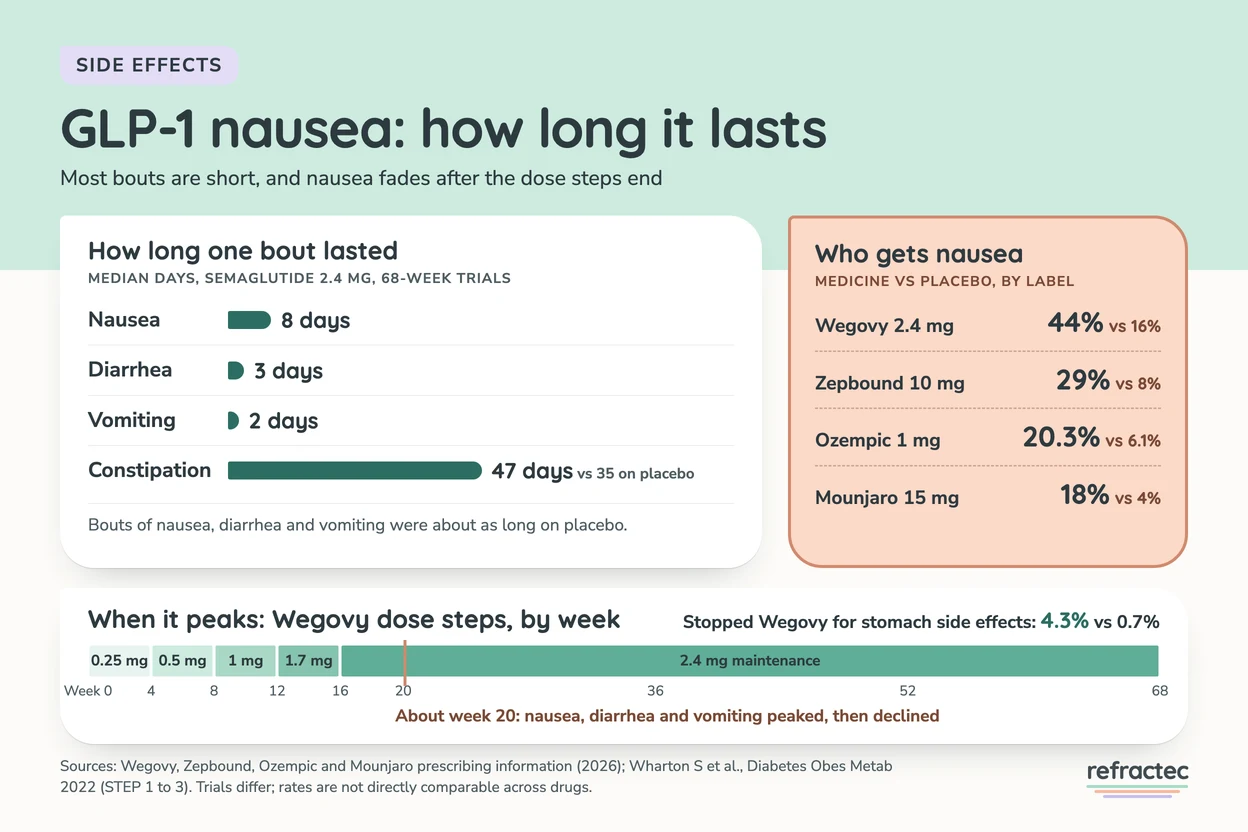
GLP-1 nausea is the side effect people notice most on semaglutide and tirzepatide. For many, it comes in short bouts while the dose is going up and eases after that.1,6 This guide covers how common it is, how long it tends to last, what the labels advise, and when to call.
The numbers come from the FDA labels for Wegovy, Ozempic, Zepbound and Mounjaro. Each figure sits beside its placebo figure, because some people in every trial feel queasy on a dummy shot too.
How common is nausea on GLP-1 medicines?
Very common, especially at weight-loss doses. In Wegovy’s weight-loss trials, nausea affected about 44 in 100 adults (44%) on the 2.4 mg dose, compared with 16 in 100 on placebo.1 Taken together, 73% had some stomach or gut side effect, compared with 47% on placebo.1
On Zepbound, nausea affected 25% to 29% across the three doses, compared with 8% on placebo.3 The diabetes trials show lower rates. On Ozempic, 15.8% had nausea on 0.5 mg and 20.3% on 1 mg, compared with 6.1% on placebo.2 On Mounjaro, it was 12% to 18%, compared with 4% on placebo.5
| Side effect | Share of people, medicine then placebo |
|---|---|
| Wegovy 2.4 mg | Medicine 44%Placebo 16% |
| Zepbound 10 mg | Medicine 29%Placebo 8% |
| Ozempic 1 mg | Medicine 20.3%Placebo 6.1% |
| Mounjaro 15 mg | Medicine 18%Placebo 4% |
Share of people with nausea in each label's placebo-controlled trials, at the dose with the highest rate. Wegovy and Zepbound trials were for weight loss; Ozempic and Mounjaro trials were in type 2 diabetes. The trials differ, so the labels say not to compare rates directly across drugs.1
The trials enrolled different people for different lengths of time. The labels say rates from one drug’s trials can’t be compared directly with another drug’s.3 So use these numbers to get a sense of scale, not to pick a winner.
What about the pill? In the Wegovy 25 mg tablet trial, the common side effects were similar to the injection’s.1 Stomach side effects led 3.4% to stop the tablets, compared with 2% on placebo.1
Teens see it too. In Wegovy’s trial of young people aged 12 and older, nausea affected 42%, compared with 18% on placebo.1
How long does GLP-1 nausea last?
Most bouts are short. A pooled look at three semaglutide 2.4 mg trials followed 2,117 adults on the medicine and 1,262 on placebo for 68 weeks.6 A typical bout of nausea lasted 8 days. Diarrhea lasted 3 days and vomiting 2 days, and these lengths were similar to placebo.6
Over the whole trial, nausea was most common at about week 20, then dropped.6 That’s just after the last dose step. Of all the stomach symptoms, nausea showed the clearest drop.6
Constipation was the slow one. A typical bout lasted 47 days on semaglutide, compared with 35 days on placebo.6 The same paper found that nearly all the stomach side effects (98.1%) were mild to moderate.6
For tirzepatide, the labels say most nausea, vomiting and diarrhea happened while the dose was going up and decreased over time
.3,5 We didn’t find a published figure for how long a single bout lasts on tirzepatide. The 8-day figure above is for semaglutide only.
Why is it worse when the dose goes up?
GLP-1 medicines slow how fast food leaves your stomach.1 When food sits there longer, you can feel full sooner, bloated or queasy. Each step up in dose is a new change for your body to get used to.
The labels say stomach side effects were reported most during dose escalation.1 For tirzepatide, the label adds that the slowing of the stomach is largest after the first dose and fades over time.3
Higher doses can bring more nausea. In two Wegovy trials, nausea affected 39% on the 7.2 mg dose and 35% on 2.4 mg, compared with 13% on placebo.1 Ozempic shows the same pattern. In a trial comparing two doses, stomach side effects affected 34% on 2 mg and 30.8% on 1 mg.2
What does the label say to do?
The labels use slow dose steps to make stomach side effects less likely.1,3 Wegovy injection starts at 0.25 mg a week. It then goes to 0.5 mg, 1 mg and 1.7 mg, each for 4 weeks, before the maintenance dose from week 17.1 Zepbound and Mounjaro start at 2.5 mg a week and rise in 2.5 mg steps, at least 4 weeks apart.3,5
The labels also give your prescriber room to slow down. If a dose step is hard, the Wegovy label says to consider waiting 4 weeks before the next one.1 If a Zepbound maintenance dose is hard, the label says a lower maintenance dose can be considered.3 These are your prescriber’s calls, so don’t hold, skip or change a dose before talking with them.
Fluids matter most. The Medication Guide says It is important for you to drink fluids to help reduce your chance of dehydration.
4 It also asks you to tell your provider right away about nausea, vomiting or diarrhea that does not go away.4
What can help day to day?
The labels don’t list food tips. A group of Spanish specialists did publish advice in 2022. It is expert opinion, not trial results, and Novo Nordisk funded the work.7 Their suggestions include:
- Eat slowly, and eat smaller portions.7
- Stop eating when you start to feel full.7
- Choose bland, low-fat foods that are easy to digest.7
- Sip clear, cool drinks through the day.7
- Don’t lie down right after a meal, and avoid strong smells.7
If you’re vomiting, the same experts say to be extra careful about staying hydrated.7 Ask your pharmacist before trying any anti-nausea medicine, even one sold without a prescription.
One more thing: feeling sick isn’t a sign the medicine is working better. In the STEP trials, weight loss was similar whether or not people had stomach side effects.6
How many people stop because of nausea?
Only a few. In Wegovy’s weight-loss trials, 1.8% stopped because of nausea, compared with 0.2% on placebo.1 Counting every stomach side effect, 4.3% stopped, compared with 0.7% on placebo.1
On Zepbound, stopping because of stomach side effects rose with the dose, from 1.9% on 5 mg to 4.3% on 15 mg. That compares with 0.5% on placebo.3
When is nausea a sign of something more serious?
Ordinary nausea comes and goes. A few patterns are different and need a call or a visit.
- It won’t stop, and you’re drying out. The UK regulator says nausea, vomiting and diarrhea sometimes lead to severe dehydration that needs hospital care.8 The labels report kidney injury after fluid loss, in some cases needing dialysis.3
- Severe stomach problems. The labels warn of stomach side effects that are
sometimes severe
.1,3 In the Wegovy trials, severe ones affected 4.1% on the injection, compared with 0.9% on placebo.1 - Belly pain that is severe and won’t go away. With or without nausea, this can be a sign of pancreatitis. The pain may spread to your back.4
- Pain in your upper belly with fever or yellow skin. These can be signs of a gallbladder problem.4
- Vomiting blood, or vomit like coffee grounds. A US health institute lists this as a reason to get help right away, along with vomiting for more than an hour.9
The labels don’t set a number of days after which you should call. They use plain words instead: severe, or will not go away.4 If you’re unsure, call.
Questions to ask your prescriber
Bring these to your next appointment. Tick them off as you go.
Endnotes
- What the Wegovy label says about stomach side effects. Wegovy (semaglutide) injection and tablets, prescribing information and Medication Guide, Novo Nordisk. Revised 06/2026; DailyMed, updated Jun 18, 2026. Retrieved Oct 2026.
- What the Ozempic label says about stomach side effects. Ozempic (semaglutide) injection, prescribing information and Medication Guide, Novo Nordisk. Revised 05/2026; DailyMed, updated Jun 1, 2026. Retrieved Oct 2026.
- What the Zepbound label says about stomach side effects. Zepbound (tirzepatide) injection, prescribing information, Eli Lilly and Company. Revised 08/2026; DailyMed, updated Aug 28, 2026. Retrieved Oct 2026.
- What the Zepbound Medication Guide tells patients. Zepbound (tirzepatide) injection, Medication Guide, Eli Lilly and Company. Revised 08/2026. Retrieved Oct 2026.
- What the Mounjaro label says about stomach side effects. Mounjaro (tirzepatide) injection, prescribing information, Eli Lilly and Company. Revised 08/2026; DailyMed, updated Aug 27, 2026. Retrieved Oct 2026.
- How long stomach side effects lasted in the STEP trials. Wharton S, Calanna S, Davies M, et al. Gastrointestinal tolerability of once-weekly semaglutide 2.4 mg in adults with overweight or obesity, and the relationship between gastrointestinal adverse events and weight loss. Diabetes Obes Metab. 2022;24(1):94-105. doi:10.1111/dom.14551. Pooled analysis of the STEP 1 to 3 trials, funded by Novo Nordisk.
- Expert tips for eating with stomach side effects. Gorgojo-Martínez JJ, Mezquita-Raya P, Carretero-Gómez J, et al. Clinical Recommendations to Manage Gastrointestinal Adverse Events in Patients Treated with Glp-1 Receptor Agonists: A Multidisciplinary Expert Consensus. J Clin Med. 2022;12(1):145. doi:10.3390/jcm12010145. Expert opinion, funded by Novo Nordisk.
- The UK regulator's guide to GLP-1 side effects. Medicines and Healthcare products Regulatory Agency. GLP-1 medicines for weight loss and diabetes: what you need to know. GOV.UK, updated Feb 5, 2026. Retrieved Oct 2026.
- When gastroparesis symptoms need a doctor. National Institute of Diabetes and Digestive and Kidney Diseases. Symptoms & Causes of Gastroparesis. NIH, last reviewed Jan 2018. Retrieved Oct 2026.
Reviewed against the sources above on Oct 19, 2026. Spotted something out of date? The desk dates every correction on the page.