Interactions guides Semaglutide (Ozempic, Wegovy, Rybelsus) and tirzepatide (Mounjaro, Zepbound)
Drinking alcohol on Ozempic or another GLP-1
The labels don't mention alcohol. Here's where drinking overlaps with the risks they do list, and what research says about GLP-1s and the urge to drink.
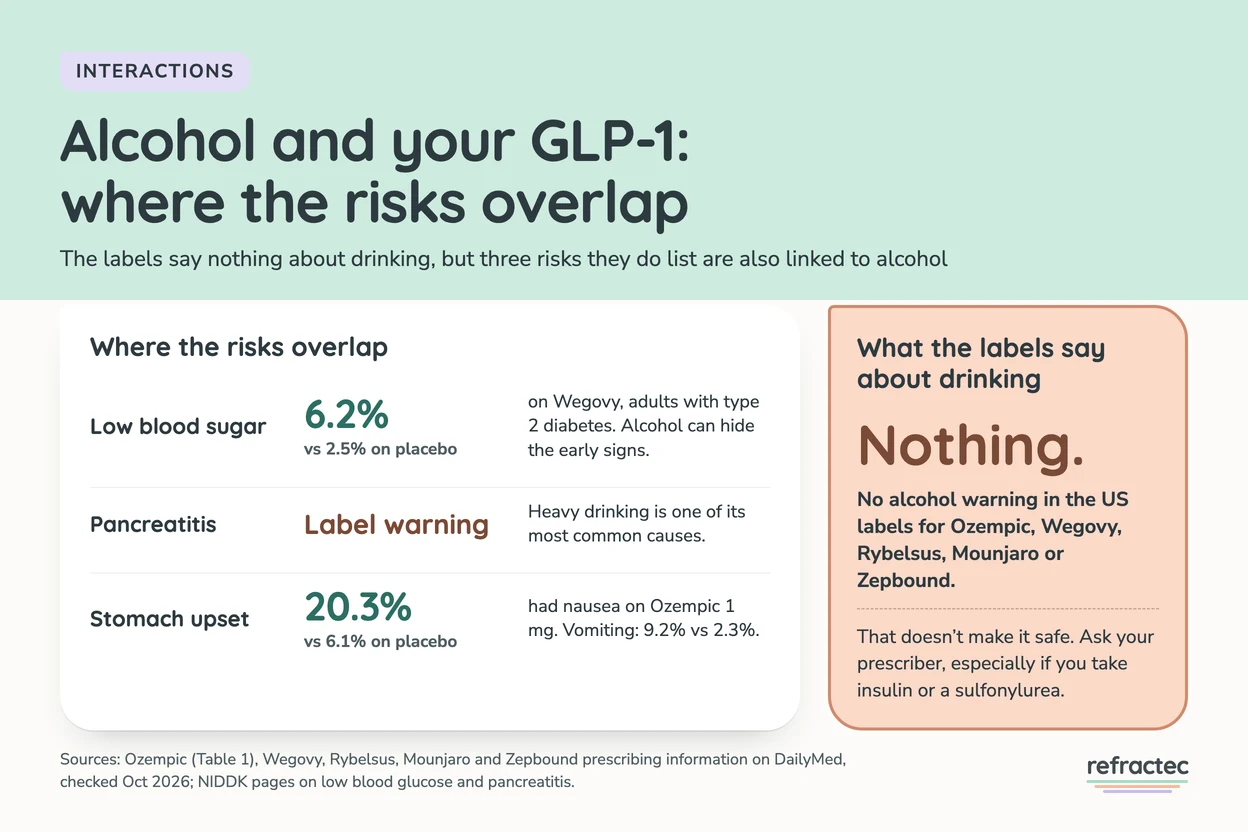
Drinking alcohol on Ozempic isn’t covered by the label at all. We read the current US labels for Ozempic, Wegovy, Rybelsus, Mounjaro and Zepbound, and none has a warning or advice about drinking.1,2,3,4,5 That silence doesn’t mean alcohol is safe with these medicines. It means it hasn’t been studied as a label question.
What the labels do list are three risks that alcohol can also cause or hide: low blood sugar, pancreatitis and stomach upset. This guide walks through each one, so you can talk it over with your prescriber.
Can you drink alcohol on Ozempic?
No regulator or label gives a yes, a no or a safe number of drinks. The answer depends on you: whether you have diabetes, which other medicines you take, and your history with your pancreas.
The overlap matters most if you have type 2 diabetes and take insulin or a sulfonylurea, such as glipizide or glyburide. Those medicines already raise the risk of low blood sugar on a GLP-1, and alcohol can add to it.1,6
What does the label say about alcohol?
The word “alcohol” does appear in these labels, but only in other ways. It shows up in alcohol swabs for cleaning the skin and in the name of a liver condition. It’s also an inactive ingredient in some tirzepatide pens and vials.1,2,4,5 None of it is about drinking.
So the rest of this guide uses two kinds of sources. The labels tell us about the medicine’s own risks. Health pages from the National Institutes of Health tell us what alcohol does on its own.
Could drinking make low blood sugar more likely?
Yes, especially if you have diabetes. The Wegovy label says the medicine lowers blood glucose and can cause hypoglycemia
.2 One trial included adults with type 2 diabetes. Low blood sugar under 54 mg/dL happened in about 6 in 100 people (6.2%) on Wegovy, compared with about 3 in 100 (2.5%) on placebo.2
Zepbound’s label reports a similar pattern: 4.2% compared with 1.3% on placebo, in adults with type 2 diabetes.4 The Ozempic label warns that taking it with insulin or a sulfonylurea may raise the risk of low blood sugar, including severe episodes.1
Alcohol adds two problems. The NIDDK says Alcohol makes it harder for your body to keep your blood glucose level steady, especially if you haven’t eaten in a while.
6 It also says alcohol can also keep you from feeling the first symptoms of low blood glucose
.6
That last point is the tricky one. Feeling dizzy, confused or shaky can look like being tipsy, to you and to the people around you. The Ozempic Medication Guide lists signs of low blood sugar such as sweating, shakiness, blurred vision, slurred speech, confusion and a fast heartbeat.1
If you have diabetes and choose to drink, the NIDDK says it’s safer to eat some food at the same time
.6 Ask your prescriber how often to check your blood sugar.
What if you don’t have diabetes? The Wegovy label notes that low blood sugar has been reported with GLP-1 medicines in adults without type 2 diabetes.2 It’s less common, but it’s worth knowing the signs.
What about pancreatitis?
Pancreatitis is swelling of the pancreas, an organ behind your stomach. Every one of these labels warns about it. The Wegovy label says the main sign is persistent or severe abdominal pain (sometimes radiating to the back)
, with or without nausea or vomiting.2
In the medicine’s own trials, it was rare. In Wegovy’s weight-loss trials, it was confirmed in 4 people on Wegovy and 1 on placebo.2 In Ozempic’s diabetes trials, it was confirmed in 7 people on Ozempic, compared with 3 on placebo or other diabetes medicines.1
Alcohol matters here because it’s a well-known cause in its own right. The NIDDK lists gallstones and heavy alcohol use as the most common causes of both short-term and long-term pancreatitis.7 No study we found shows that drinking raises pancreatitis risk on a GLP-1 more than it does without one. Still, the two risks point at the same organ.
If you’ve had pancreatitis before, tell your prescriber. The Ozempic Medication Guide asks you to mention any past problems with your pancreas before you start.1
Will alcohol make the nausea worse?
The labels can’t answer that, because their numbers come from trials that didn’t track drinking. What they do show is how common stomach side effects are on the medicine alone.
| Side effect | Share of people, medicine then placebo |
|---|---|
| Nausea | Medicine 20.3%Placebo 6.1% |
| Vomiting | Medicine 9.2%Placebo 2.3% |
| Diarrhea | Medicine 8.8%Placebo 1.9% |
| Stomach pain | Medicine 5.7%Placebo 4.6% |
| Constipation | Medicine 3.1%Placebo 1.5% |
Share of adults with type 2 diabetes with each side effect in Ozempic's pooled placebo-controlled trials (261 on Ozempic 1 mg, 262 on placebo). These are label figures without alcohol in the picture.1
On Ozempic 1 mg, nausea affected about 20 in 100 people (20.3%), compared with about 6 in 100 (6.1%) on placebo. Vomiting affected 9.2% compared with 2.3%.1 Most nausea, vomiting and diarrhea happened while the dose was going up.1
GLP-1 medicines also slow how fast food leaves your stomach.2 Many people already feel full or queasy sooner. If drinks make that worse for you, that’s useful to tell your prescriber.
Can drinking lead to dehydration and kidney problems?
It can add to the risk. The labels warn that vomiting and diarrhea can cause you to lose fluids, and that this has led to kidney injury in some people.1,2 In Wegovy’s weight-loss trials, kidney injury happened in 7 people on Wegovy and 4 on placebo. Some cases came with stomach side effects or dehydration.2
The labels don’t mention alcohol here. But if a night of drinking leaves you vomiting, or you can’t keep fluids down, the same fluid loss applies. Drink water and call your prescriber if it doesn’t settle.
Do GLP-1 medicines change how much people want to drink?
Researchers are asking this, but the answer isn’t settled. No GLP-1 medicine is approved to treat alcohol use disorder.1,2,4,5
A small trial gave low doses of semaglutide or placebo to 48 adults with alcohol use disorder for 9 weeks.8 The trial found that semaglutide did not affect average drinks per calendar day or number of drinking days, but significantly reduced drinks per drinking day
.8 People on semaglutide also drank less during a lab drinking test.8
An older GLP-1, exenatide, was tested in 127 people with alcohol use disorder for 26 weeks. It did not cut the number of heavy drinking days, the trial’s main goal.9 A Swedish register study of 227,866 people with alcohol use disorder linked semaglutide with fewer hospital stays for alcohol.10 That was an observational study, so it shows a link, not proof.
Some people say they want to drink less on a GLP-1. That’s worth sharing with your prescriber, but it isn’t a treatment plan. If you want help cutting back, ask about treatments that are proven for that.
What can you do if you choose to drink?
Start with a talk with your prescriber, since the right answer depends on your health and your other medicines. If you do drink, a few steps follow from the risks above.
- Eat at the same time. The NIDDK says this is safer for people with diabetes who drink.6
- Drink water too. The Ozempic Medication Guide says
It is important for you to drink fluids to help reduce your chance of dehydration.
1 - Know the signs of low blood sugar. Make sure someone you’re with knows them too, since they can look like being drunk.1,6
- Notice how your stomach reacts. If drinks bring on nausea, vomiting or belly pain, tell your prescriber.
Questions to ask your prescriber
Bring these to your next appointment. Tick them off as you go.
Endnotes
- What the Ozempic label says about side effects. Ozempic (semaglutide) injection, prescribing information and Medication Guide, Novo Nordisk. DailyMed, label revised 5/2026, sections 5, 6.1 (Table 1) and 7. Retrieved Oct 2026.
- What the Wegovy label says about low blood sugar, pancreatitis and dehydration. Wegovy (semaglutide) injection and tablets, prescribing information and Medication Guide, Novo Nordisk. DailyMed, label revised 6/2026, sections 5.2, 5.4, 5.5 and 6.1. Retrieved Oct 2026.
- The Rybelsus label. Rybelsus and Ozempic (semaglutide) tablets, prescribing information, Novo Nordisk. DailyMed, label revised 1/2026. Retrieved Oct 2026.
- The Zepbound label. Zepbound (tirzepatide) injection, prescribing information, Eli Lilly and Company. DailyMed, label revised 8/2026, section 5.7. Retrieved Oct 2026.
- The Mounjaro label. Mounjaro (tirzepatide) injection, prescribing information, Eli Lilly and Company. DailyMed, label revised 8/2026. Retrieved Oct 2026.
- How alcohol affects low blood sugar. National Institute of Diabetes and Digestive and Kidney Diseases (NIDDK). Low blood glucose (hypoglycemia). Last reviewed Jul 2021. Retrieved Oct 2026.
- What causes pancreatitis. National Institute of Diabetes and Digestive and Kidney Diseases (NIDDK). Symptoms and causes of pancreatitis. Last reviewed Nov 2017. Retrieved Oct 2026.
- A small trial of semaglutide in people with alcohol use disorder. Hendershot CS, Bremmer MP, Paladino MB, et al. Once-weekly semaglutide in adults with alcohol use disorder: a randomized clinical trial. JAMA Psychiatry. 2025;82(4):395-405. doi:10.1001/jamapsychiatry.2024.4789.
- A trial of an older GLP-1, exenatide. Klausen MK, Jensen ME, Møller M, et al. Exenatide once weekly for alcohol use disorder investigated in a randomized, placebo-controlled clinical trial. JCI Insight. 2022;7(19):e159863. doi:10.1172/jci.insight.159863.
- A Swedish register study of hospital stays. Lähteenvuo M, Tiihonen J, Solismaa A, et al. Repurposing semaglutide and liraglutide for alcohol use disorder. JAMA Psychiatry. 2025;82(1):94-98. doi:10.1001/jamapsychiatry.2024.3599.
Reviewed against the sources above on Oct 20, 2026. Spotted something out of date? The desk dates every correction on the page.